Why I’m Sounding the Horn on Iowa’s Data Centers
I remember when the drive from Adventureland back to my home in the suburbs was a “windows down” kind of trip. It was a beautiful stretch of back roads, open land, and those iconic Iowa farm fields that make you feel like you’re exactly where you belong.
But lately, that view has disappeared.
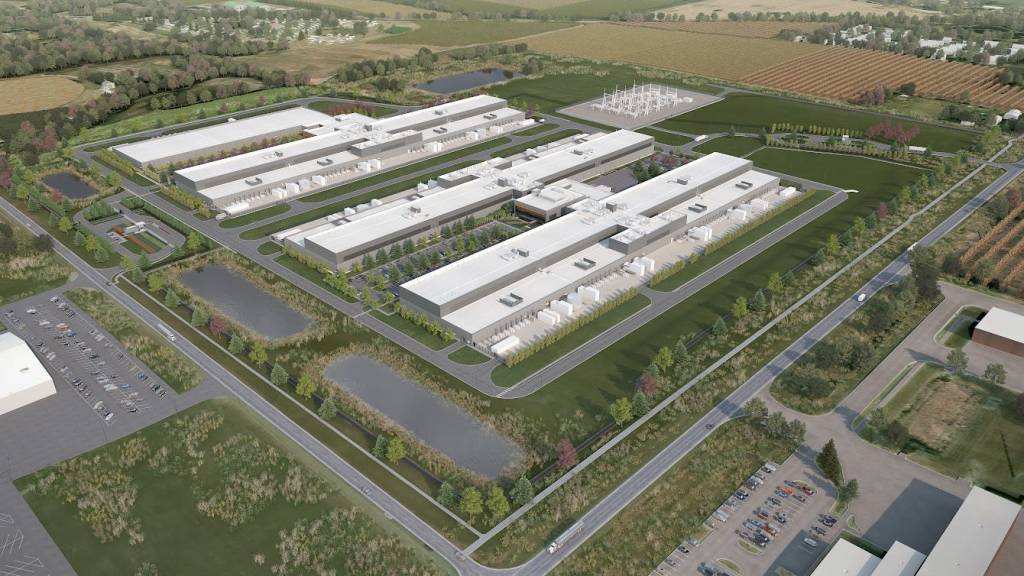
What used to be rolling fields and agriculture is now filled with the cold, gray walls of data centers. These aren’t just eyesores; they are a permanent stain on our beautiful Iowa landscape. And while the local governments tout them as “progress,” I’m here to sound the horn on what we’re actually losing.
The Real Cost of “The Cloud”
We’ve watched these facilities take over Central Iowa rapidly. In Altoona, the Meta (Facebook) campus now covers over 520 acres, land that used to be our state’s greatest asset. In West Des Moines, Microsoft has been gobbling up hundreds of acres for their own projects.
These companies aren’t just taking our land; they are sucking up our resources:
- Water Guzzlers: A single data center can consume between 300,000 and 1.25 million gallons of water every single day just to keep their servers cool. In Council Bluffs, Google’s facility used 1 billion gallons in a single year.
- Power Hunger: These centers can account for up to 8% of a community’s total water usage and put an immense strain on our electric grid, often leading to higher utility bills for the rest of us.
The David and Goliath of Des Moines: Real Jobs vs. Empty Buildings
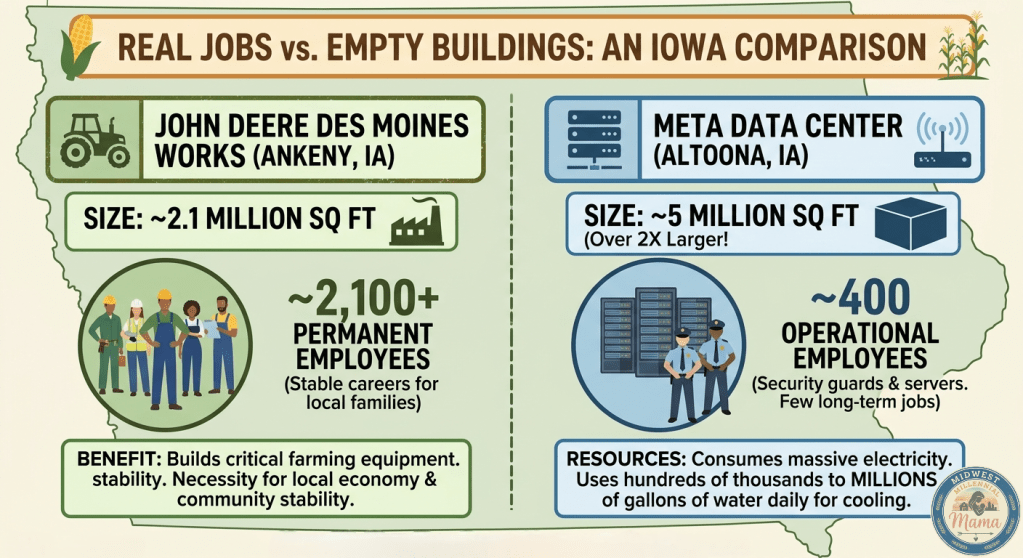
To put the sheer scale of this into perspective, let’s look at the John Deere Des Moines Works plant in Ankeny, where my husband works. That facility is massive, clocking in at just over 2 million square feet. It is an economic engine for our community, providing a necessary product for farming and employing thousands of hardworking Iowans. Its footprint on our land is a necessity for the stability of our local economy.
Now, compare that to the Meta data center in Altoona. Meta’s campus is now over 5 million square feet, more than double the size of the John Deere plant. But here is the kicker:
- John Deere (Ankeny): Employs approximately 2,100 people in stable, long-term manufacturing and engineering roles.
- Meta Data Center (Altoona): Despite being twice the size, it only supports a few hundred operational jobs.
Once those temporary construction crews pack up and leave, these massive “boxes” sit mostly empty. The primary residents of these multi-million square foot buildings?
Servers and security guards. We are handing over masses of our most fertile land to companies that provide little to no long-term benefit to the actual people living here. While John Deere helps feed the world and supports thousands of local families, these data centers are just “ghost buildings” quietly sucking up our water and electricity while offering nothing but a fence and a security detail in return.
A Legacy of “Poison,” Not Progress
The County Supervisors and city leaders want us to believe this is “sustainable growth.” But temporary construction jobs don’t equate to a healthy future for our communities.
When our children look back, they won’t see “tech innovation.” They will see that we traded their valuable, fertile land for massive steel boxes that drained their water and electricity. We aren’t enabling the next generation with technology; we are hindering them by handing over their natural resources to the highest bidder.
It’s time we stop being “Iowa Nice” about companies that don’t have our best interests at heart.
Our land is worth more than a server farm.
Our future is worth more than a data center.

